
Talking to Strangers
It usually works and often creates huge psychic benefits.

Human beings are highly social creatures, made happier and healthier by connecting with other people. Yet every day offers opportunities to connect that we choose not to take. We avoid talking to strangers. Once talking, we stick to small talk. We feel grateful but don’t express it, need help but don’t ask, could express support but don’t. By any measure, social isolation in America is on the rise. If being social is good for us, why do we choose to be so unsocial?
This is the opening paragraph of Nicholas Epley, “The Science of Talking to Strangers,” Wall Street Journal, May 29, 2026 (May 30-31 print.)
Epley goes on to mention a small risk he took by commenting positively on the hat worn by a fellow passenger on the commuter train he took to the University of Chicago.
The risk paid off. Epley goes on to talk about how that one interaction led him to research the issue. (Epley is a professor of behavioral science at the University of Chicago’s Booth School of Business. He has written a book on the issue.)
I’ve known for years that the risk pays off. Indeed, although I didn’t know the psychological term “depression” when I was 12, I did know that whatever the word was, I was moderately depressed. I found that 4 things helped with my depression: (1) exercise, (2) listening to music especially classical music and upbeat modern music, (3) interacting with people, and (4) eating moderate amounts of dark chocolate. All of those still work, to the point where few people would think of me as being depressed. (One thing I learned much later in life is that when I feel depressed, I can start writing on whatever Substack post or article I’m working on and, within 20 minutes, feel the depression lifting.)
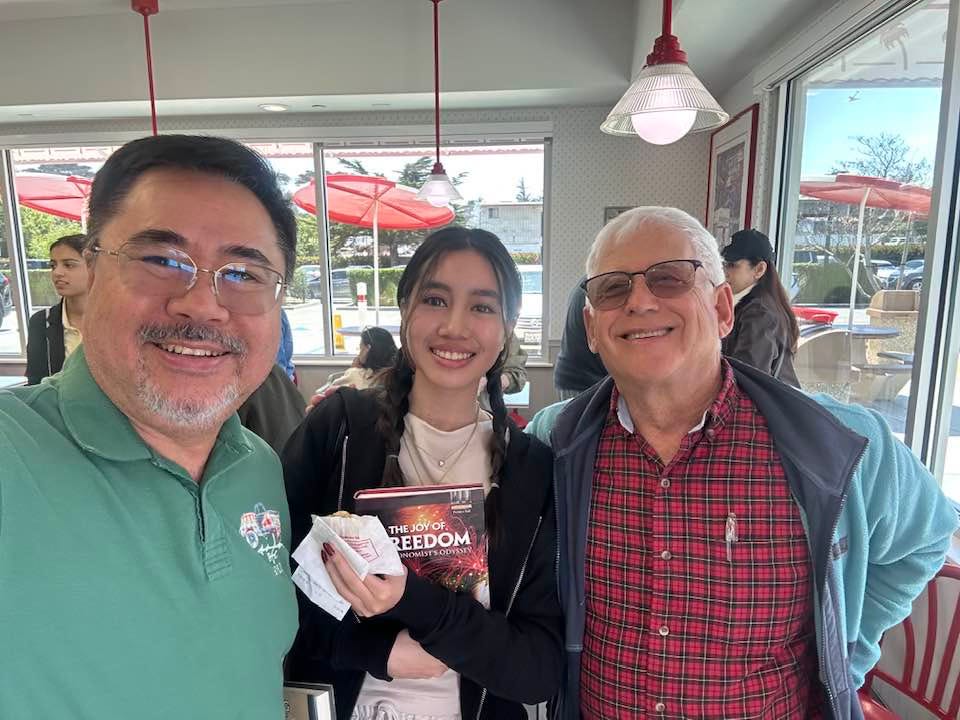
I had a very positive interaction with two strangers last week. I was at In-N-Out Burger for my once-a-week burger and the place was packed. It was the busiest I had ever seen. People were looking for tables and I got lucky: an employee was cleaning a table that had just been vacated and, after he finished, I sat. I looked around and saw a guy looking for a table. I went up to him and offered to let him sit. He thanked me but said he had a big family with him. So I sat down and started reading my book.
A few minutes later, I saw an Asian guy with, presumably, his wife and teenage daughter. I went up to them and offered them space. The man declined pleasantly, saying that they were part of a bigger group. So I sat back down and kept reading.
Just a few minutes later, though, the teenage daughter came to my table and asked if she could sit. I said she could.
She was very outgoing. She asked me questions about myself, what I did for a living, how I came to be an economist, how old I was. I enjoyed it. I often tell people that a good strategy when meeting new people is to ask them about themselves because, for most people, it gives them a chance to talk about their favorite subject. I’m no exception.
I did manage to turn the issue to her and found out that she is a college student from Manila and that her family was visiting the United States. Her father came over a few minutes later and I learned from him that he makes a living by leasing apartments in Manila.
I had given his 19-year-old daughter the short version of how I had become an economist, and offered to go to my car and get The Joy of Freedom: An Economist’s Odyssey so that she could read the long version: Chapter 2, “Hooked on Economics.” I also brought back a copy of Charley Hooper’s and my book, Making Great Decisions in Business and Life, and gave it to her father.
The three of us talked more and then her father went back to the table where the other relatives were.
The daughter and I talked more. I told her that with the onset of AI, she has a huge advantage over most people her age: she’s forward and outgoing.
The father remembered to do what I often forget to do because I’m so in the moment with visiting: take pictures. The picture on this post is of the father, the daughter, and me.
"She was very outgoing. She asked me questions about myself, what I did for a living, how I came to be an economist, how old I was. I enjoyed it. I often tell people that a good strategy when meeting new people is to ask them about themselves because, for most people, it gives them a chance to talk about their favorite subject. I’m no exception."
Dale Carnegie - How to Win Friends and Influence People.
Trust me this single point better than the ANYTHING inside of 'Art of the Deal' by DT
“I found that 4 things helped with my depression: (1) exercise, (2) listening to music especially classical music and upbeat modern music, (3) interacting with people, and (4) eating moderate amounts of dark chocolate.”
I love his list but now I’m depressed. I only completed three of the four—and I forgot to buy dark chocolate covered walnuts at Kroger’s today—ughhhh!
PS—Please don’t worry. I will just drink some red wine—a nice Cote du Rhone.