
Humor-Nomics

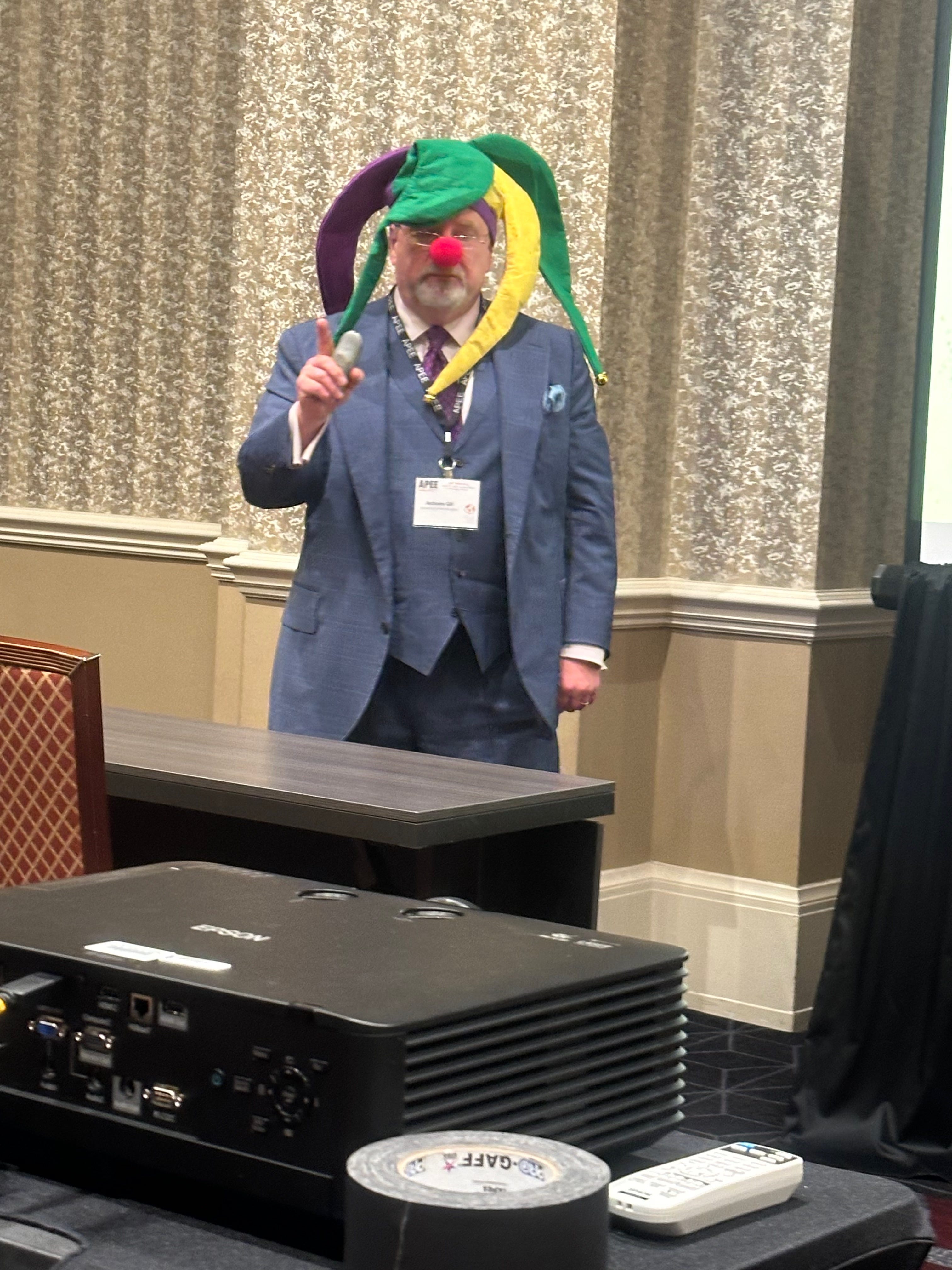
The title of this Substack post was also the title of a session held at the Association for Private Enterprise Education (APEE) annual meetings in Las Vegas earlier this week. The session was held at 8:00 a.m yesterday. The fact that I was willing to get up before 7:00 a.m. to make it on time to an 8:00 a.m. session should tell you something about my expectations.
I was not disappointed.
The organizer was Craig Richardson of Winston-Salem State University. He was the lead presenter. The other 3 presenters were Anthony Gill of the University of Washington, Terry Kibbe of Free the People, and Zagros Madjd-Sadjadi of Winston-Salem State University. I liked all of the presentations a lot. My favorite was the one by Zagros. Interestingly, he was also someone I hadn’t known of before yesterday.
In his presentation, Craig showed a bar graph of the number of times a day a young child laughs and the number of times an adult laughs. For the child, it was well over 100; for the adult it was about 15. One fellow audience member started cracking up at one of the first funny lines. The group was intimate enough that I said out loud to the guy, “You’ve already hit one of your 15.” He laughed a lot more through the whole thing.
The main serious point made by the presenters was that humor is a great way to teach economics, as long as you don’t overdo it. Zagros told of running into students years later who remembered a funny story and then remembered the principle that that story illustrated. Zagros speculated—and I’m virtually positive that he’s right—that without that funny story, the student would not have remembered the principle.
While I probably didn’t use humor as much as Zagros in my teaching, I definitely used stories. And I would similarly find students years later who remembered the principle by the story that went with it. Indeed, Charley Hooper and I wrote our whole book, Making Great Decisions in Business and Life, by telling stories and then stating the principle.
Tony Gill made a more complex point about the important role of jesters as truth tellers who give important feedback to kings. It’s based on a paper he wrote with economist Glen Whitman.
While those know Tony know that he often shows up wearing a cowboy hat, I got a great picture of him wearing a jester’s hat.
“Tony Gill made a more complex point about the important role of jesters as truth tellers who give important feedback to kings.”
There were of course limits to this.
As the story of the jester who told *such* terrible puns that he was ordered by the king to stop or he would be hanged makes clear.
Of course the jester’s compulsion to pun was such that - though not in front of the king - within less than two days he had punned again. And so was thrown into prison to await his punishment.
A few days later, the king had second thoughts, and decided to spare the jester.
The jester was brought in front of the king, who told him he would spare his life, so long as he a) apologized and b) agreed never to pun again in the presence of the king.
King: “Do you understand these terms? What do you have to say for yourself?”
Jester: “Yes. No noose is good noose...”
My father told a story of the idiot in his village.
Smart guys at the bar where Idiot hung out would have fun with him, offering him the choice between a great, big nickel, or a skinny little dime. Idiot always pondered, then opted for the big, shiny nickel.
My father, looking to spoil this game, took Idiot aside and asked him, "Don't you know the dime is worth more?"
Idiot said, "Of course I know that!"
So my father said, "So why don't you choose the dime?"
Idiot looked at Dad with disdain. "Cause if I ever did, they'd stop giving me nickels."